Windows 95 Virtualbox Image S
.What You’ll Need You’ll need two things for this: A Windows 95 ISO file and a Windows 95 boot disk image. Unlike modern operating systems, the Windows 95 installation disc isn’t bootable. You must first boot into an MS-DOS environment from a Windows 95 boot disk, which would have been a floppy disk at the time, to get the installation started.
If you have an old Windows 95 CD lying around, you can insert it into your PC. While ISO files of Windows 95 are available online, bear in mind that Windows 95 is still under Microsoft copyright, and can’t be legally downloaded from the web.So start digging through those old drawers of yours. Once you’ve got your Windows 95 ISO file, you can download a boot diskette image from.
You will probably just need to download the “Windows95a.img” file. Windows 95b (also known as Windows 95 OSR2) was only available to OEMs (Original Equipment Manufacturers), so any Windows 95 disc you have lying around will either by the original Windows 95 release (also known as Windows 95 RTM) or the Windows 95a release (also known as Windows 95 OSR1), which came with Service Pack 1 installed.Before you install Windows 95 in, you can download Windows 95 to your computer at the bottom of the. Since the Windows 95 ISO image is on the R.Step One: Create Your Virtual Machine. We’ll be doing this in, which is completely free to use and available on Windows, macOS, and Linux.
Windows 3.1 Virtualbox Image
You can do it in other programs like VMware, but the process of configuring the virtual machine software will be a little different. Once you have VirtualBox installed, click the “New” button to create a new virtual machine. Enter whatever name you like and select “Windows 95” from the Version box.
If you name it “Windows 95”, VirtualBox will automatically choose the correct Windows version. Choose how much RAM you want to expose to your virtual machine.VirtualBox recommends 64 MB, while official Microsoft blog claims that Windows 95 won’t boot if it has more than around 480 MB of memory. You could split the difference and safely use 256 MB, which would be more than enough for old Windows 95 applications. Continue through the wizard until you’re prompted to create your virtual hard disk. VirtualBox will automatically suggest 2.0 GB, and you probably don’t want to go over that.
The retail versions of Windows 95 only support the FAT16 file system, which means they can’t use drives over 2 GB in size.Windows 95b (aka OSR2), which was only released to device manufactures and never sold at retail, does support. So, if you were using this version of Windows 95, you could theoretically use up to 32 GB of space. Don’t boot up the machine right after you’re finished creating it.
First, you’ll need to change a few settings.Right-click your Windows 95 virtual machine and select “Settings”. Click the “System” category, click the “Acceleration” tab, and uncheck “Enable VT-x/AMD-V”.
If you leave this option enabled, you’ll be able to install Windows 95, but it will just show a black screen when it boots up afterwards. Next, click the “Storage” category and select the virtual drive under the Floppy controller. Click the floppy disk button to the right of Floppy Drive and click “Choose Virtual Floppy Disk File” in the menu. Browse to the boot disk.img file and select it.Finally, click the Empty disc drive under the IDE controller, click the disc icon to the right of Optical Drive, and click “Choose Virtual Optical DIsk File”.
Browse to your Windows 95 ISO file and select it. Click “OK” to save your settings when you’re done. Step Two: Prepare Your Virtual C: Drive You can now just double-click the Windows 95 virtual machine in your library to boot it up. It will boot to a DOS prompt. Note that the virtual machine will capture your keyboard and mouse once you click inside it, but you can press the host key—that’s the right Ctrl key on your keyboard, by default—to free your input and use your PC’s desktop normally.The key is displayed at the bottom right corner of the virtual machine window. First, you’ll need to partition the virtual drive you created.Type the following command at the prompt and press Enter: fdisk This process is very simple. You’ll be starting with an empty drive, so you just want to create a DOS partition.
That’s the default option, which is “1”. You just need to accept the default options to go through the fdisk process.You can just press “Enter” three times after launching fdisk to create a DOS partition, create a primary partition, and agree that you want to use the maximum size of the drive and make the partition active. You’ll be told you have to restart your virtual machine before continuing. To do this, click Input Keyboard Insert Ctrl-Alt-Del in VirtualBox.Press the right Ctrl key to free your mouse first, if necessary.
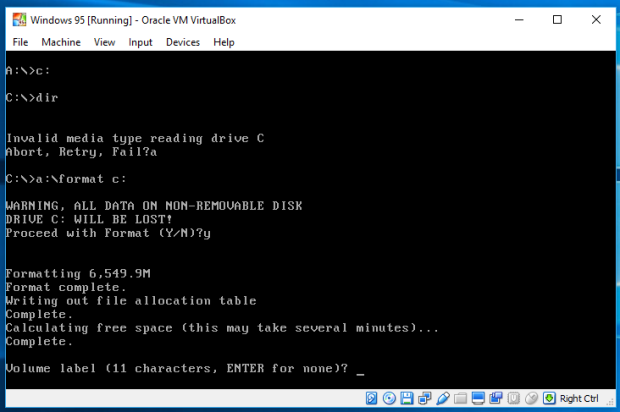
You’ll now need to format your new partition, which will be available in the virtual machine as the C: drive. To format it, type the following command at the A: prompt and press Enter: format c: Type Y and press Enter to agree to the format process when prompted. You’ll then be prompted to Enter a label for the drive. You can enter whatever you like, or nothing at all.Press “Enter” afterwards to finish the process. Step Three: Launch the Windows 95 Installer You will now need to copy the files from the Windows 95 ISO file to your C: drive.
Theoretically, you should just be able to run the Setup program from the disc drive itself to install Windows 95. However, this produces errors, as the disc drive isn’t mounted after the installer reboots, and the installer isn’t able to find driver files it needs.Instead, we found it much easier to simply copy the files to the C: drive and run the installer from there. First, figure out which drive letter your disc drive was mounted as. This is displayed when your virtual machine boots up. On our virtual machine, it’s the R: drive.If you forgot and can’t see it on your screen, you can always restart your virtual machine once again with the Ctrl+Alt+Delete option in the keyboard menu to view this info.
Run the following command to copy the files from the Windows 95 disc to your C: drive, replacing R: with whatever drive letter corresponds to your virtual disc drive. Xcopy R: C: INSTALL /S When the process is complete, you can now switch to your C: drive and launch the setup program from the INSTALL program, like so: c: cd INSTALL setup Press Enter once again to continue when prompted. The graphical Windows 95 setup program will appear. From here on out, you can do everything graphically without messing with the DOS prompt. The actual installation process is simple.On most screens, you can accept the default options and speed through the process. You will be prompted to enter your Windows 95 product key before the installation process finishes, however. Different editions of Windows 95 require different product keys, so ensure you’re using the correct key.When you reach the Analyzing Your Computer screen, be sure to check the “Network Adapter” and “Sound, MIDI, or Video Capture Card” options to ensure all the virtual machine’s hardware is correctly detected and configured.
When you’re asked to create a Startup Disk, you can select “No, I do not want a startup disk” to continue. This isn’t 1995 and you’re not installing this on a real PC, after all.The actual installation process will be extremely quick on modern hardware, even in a virtual machine. At the end of the setup process, Windows will prompt you to reboot and tell you to remove the floppy disk from your computer. To do this, click Devices Floppy Drive Remove Disk From Virtual Drive. Click “OK” to reboot your PC and continue afterwards. The setup process will continue setting up your hardware. You’ll be told you have to provide a name to continue, but you can enter anything you like here.Finally, you’ll be prompted to provide your time zone and set up a printer.
You can just click “Cancel” in the Add Printer Wizard window to skip configuring a printer when it appears. Finally, your PC will reboot and you’ll be prompted to create a password.You’ll then be presented with the Windows 95 desktop. You’re done—you now have a Windows 95 virtual machine.
To really get back into the 90’s, open Windows Explorer from Windows 95’s Start menu and head to the C: Install Funstuff Videos folder.You’ll find music videos for Weezer’s Buddy Holly (“Weezer”) and Edie Brickell’s Good Times (“Goodtime”), which were included on the Windows 95 disc. There’s also a movie trailer for the movie Rob Roy, which was also released in 1995. The videos in the “Highperf” folder are higher quality than the ones in the main Videos folder, so be sure to watch those—your modern PC can handle them!VMware Workstation 3.2 Windows 95 Installation Guidelines Windows 95 Installation Guidelines You can install Windows 95 in a virtual machine using a standard Windows 95 boot floppy and CD-ROM. Note: Some Microsoft Windows 95 OEM disks included with new computers are for those computers and include device drivers and other utilities specific to the hardware system.
Even if you can install this Windows 95 operating system on your actual computer, you may not be able to install it within a VMware Workstation virtual machine. You may need to purchase a new copy of Windows to install within a virtual machine. Note: Some Windows 95 distributions provide instructions that do not include the steps to FDISK and FORMAT a C: drive.You must FDISK and FORMAT the VMware Workstation virtual hard disk drives before running Windows 95 setup. The instructions below are for the simplest case of one virtual IDE hard drive and one virtual IDE CD-ROM drive. If you have configured the virtual machine with more than one IDE hard drive, you should also FDISK and FORMAT these drives before installing Windows 95. If you have configured the virtual machine with more than one virtual hard drive or more than one virtual CD-ROM, you may need to use different device letters than those in the instructions below.Before installing the operating system, be sure that you have already created a directory for the new virtual machine and configured it using the VMware Workstation New Virtual Machine Wizard (on Windows hosts) or Configuration Wizard (on Linux hosts).
Installation Steps Installation Steps. Use the VMware Workstation Configuration Editor to verify the virtual machine's devices are set up as you expect before starting the installation. For example, if you would like the Windows 95 setup program to install a sound driver, be sure that sound is enabled in the virtual machine's configuration. VMware also recommends that you disable the screen saver on the host system before starting the installation process. Insert the Windows 95 CD-ROM Setup Boot Disk in floppy drive A: and insert the Windows 95 CD in the CD-ROM drive.
Power on the virtual machine.After the virtual machine boots, if you are presented with a choice of CD-ROM drivers, select the first IDE driver option available (even if your computer has a SCSI CD-ROM drive). Partition the virtual disk.
A: FDISK Answer the questions.Note: If you create a primary partition that is smaller than the size of the hard disk, be sure the partition is marked active. Reboot Windows 95.If the cursor is not already within the VMware Workstation window, click in the window, then press Ctrl-Alt-Ins on a Windows host or Ctrl-Alt-Del on a Linux host. If prompted on reboot to select a CD-ROM driver, select the first IDE CD-ROM driver from the list. Format the C: drive. A: FORMAT C: /S.Start the Windows 95 installation.
A: D: WIN95 SETUP /IS Note: An intermittent problem can occur during Windows 95 installations in a virtual machine. Shortly after the Windows 95 Setup program is started, Scandisk runs to completion, and when the Windows 95 Setup program should start its graphical user interface, the virtual machine returns to an MS-DOS prompt.
VMware recommends you reboot the virtual machine and rerun Windows 95 Setup. You do not need to FDISK or FORMAT the drive again.If this problem occurs reproducibly, please report it to VMware technical support. If the virtual machine's Ethernet adapter is enabled, you have to manually add an Ethernet driver because Windows 95 does not detect it during the Analyzing Computer phase (even if you selected the Network Adapter detection option). Do the following to enable networking. Continue with the Windows 95 installation, until you get to the Windows 95 Setup Wizard/Setup Options screen.Change the default setting from Typical to Custom and click Next to continue.
From the Network Configuration screen (which appears after the Analyzing Computer phase), click Add, select the Adapter component, select Advanced Micro Devices from the manufacturer window and AMD PCNET Family Ethernet Adapter(PCI&ISA) from the network adapter window. If you need TCP/IP networking, add it from the Network Configuration screen (Windows 95 Setup does not enable TCP/IP by default).If you don't do this, the first phase of the Windows 95 installation does not copy some of the files it will need later, and the entire installation fails. Also be sure that the Microsoft NetBEUI protocol is installed. It may not be installed by default. Finish the Windows 95 installation. VMware Workstation's virtual disks support DMA transfers for better performance. The feature can be enabled after Windows 95 has been successfully installed on a virtual IDE disk.Follow these steps to enable the feature.
Right-click My Computer and select Properties. From the System Properties dialog box, click the Device Manager tab.Double-click the Disk Drives device category. Double-click the GENERIC IDE DISK TYPE01 device. Click the Settings tab and select the DMA check box. VMware Tools VMware Tools Be sure to install VMware Tools in your guest operating system. For details, see.
Enabling Sound After Installing Windows 95 Enabling Sound After Installing Windows 95 If sound was disabled at the time you installed Windows 95, you can enabled it after the operating system has been installed. To set up the virtual machine to play sound, see.Enabling Networking After Installing Windows 95 Enabling Networking After Installing Windows 95 If networking was disabled at the time you installed Windows 95, you can enable it after the operating system has been installed. To set up networking for a virtual machine, follow the instructions below.Windows Host Windows Host. Shut down Windows 95 and power off the virtual machine.
From the VMware Workstation window, on the Settings menu, choose Configuration Editor and click Add. Follow the instructions in the Add Hardware Wizard to add a virtual Ethernet adapter.Power on the virtual machine.
When Windows 95 reboots, it auto-detects an AMD PCNET Family Ethernet Adapter (PCI&ISA) and prompts for the Windows 95 CD-ROM to install drivers. The default Ethernet adapter settings should work fine and do not need to be changed. Double-click the Network icon in the Control Panel to view or change network settings. For example, you may want to add the TCP/IP protocol since Windows 95 does not install it by default.Linux Host Linux Host. Shut down Windows 95 and power off the virtual machine.From the main program window, on the Settings menu, choose Configuration Editor and open the Ethernet Adapters panel. Select a network connection type for the virtual machine and click the Install button.
Planirane kule doprinose prostornoj definiciji centralne zone Novog Beograda.URBANISTICKI PARAMETRIBlok 25Blok 26minimalna spratnost P+7minimalna spratnost P+6maksimalna spratnost P+28maksimalna spratnost P+35tipologija otvorenog blokatipologija lucnog traktaindeks izgradjenosti 1.5indeks izgradjenosti 3stepen zauzetosti 20%stepen zauzetosti 20%. Najtezi matematicki zadatak.
Virtualbox Windows 95 IsoClick OK to save the updated configuration, then power on the virtual machine. When Windows 95 reboots, it auto-detects an AMD PCNET Family Ethernet Adapter (PCI&ISA) and prompts for the Windows 95 CD-ROM to install drivers. The default Ethernet adapter settings should work fine and do not need to be changed. Double-click the Network icon in the Control Panel to view or change network settings. For example, you may want to add the TCP/IP protocol since Windows 95 does not install it by default.Known Issues Known Issues After Windows 95 has been installed, you may find that networking is not working in the guest operating system. There are several things you should check. Either remove your virtual machine's virtual USB adapter using the Configuration Editor ( Settings Configuration Editor) or - if your release of Windows 95 includes USB support - be sure the USB drivers are installed.
Oracle Virtualbox Images
Check the Windows 95 Device Manager to see if COM5 and COM6 devices are listed. If they are, disable or remove them.Be sure that NetBEUI was installed when you set up networking.
Be sure that Windows 95 Plug and Play properly detected the virtual Ethernet adapter. If it did not, you may need to use the Device Manager to remove the adapter, then reinstall it using the Add New Hardware control panel.On a Linux host with an XFree86 3.x X server, it is best not to run a screen saver in the guest operating system. Guest screen savers that demand a lot of power can cause the X server on the host to freeze.
After Windows 95 has been installed, you may notice Unknown, COM5 and COM6 devices exist in the Windows Device Manager. These devices do not actually exist and are not consuming IRQ or other resources.You may remove them using the Windows Device Manager if you like. Support for EMM386.EXE and other memory managers is currently limited. Windows 95 Virtualbox MachineIf you plan to boot initially using a customized non-standard MS-DOS or Windows 95 boot disk, be sure that EMM386.EXE (or other memory manager) is not being loaded. HIMEM.SYS and RAMDRIVE.SYS can be loaded and used without problems.camfortroulette.