Ss7 Signaling Protocol Pdf
SS7 Tutorial Tutorial on SS7 ProtocolThis SS7 Tutorial covers SS7 (Signaling System No.7) basics as defined in CCITT.The tutorial on SS7 protocol covers SS7 terminology, SS7 network, SS7 protocol stack, SS7 frame structure and SS7 signal units.SS7 terminologyTrunk- Interexchange connection is called trunk.SSP- Signal Switching point, SS7 capable telephone exchange which originate, switch and terminate calls.STP- Signal Transfer Point, packet switches of the SS7 network, perform routing functions. It allow exchanges to send and receive signaling information from each other.SCP- Signal Control Point, databases that support advanced call processing functions. Used in free phone services where called party is charged for the call made.Tandem- Trunk Automatic Exchange, this connects two exchanges which might not have a direct trunk between them.SS7 network overviewAs shown in the figure, typical SS7 network is composed of CO, STP, SCP and tandem.All these entities are interconnected with signaling links, subscriber links and trunks.CO has same functions as SSP.
CO has subscriber lines to connect to subscriber, trunk lines to connect to another exchange and signaling lines to connect with STP. Tandem does not have subscriber lines, it has only traffic trunk lines and signaling trunk lines. Let us understand how this works.-Let us assume that a subscriber in exchange 1 dials a number 1-600-111-123. 1-600 numbers are virtual numbers; they will be mapped to real numbers available and existing.-When Exchange 1 receives the dialed digits, it decides to send a message to the SCP.-SCP is the database as mentioned which contains the information as to which number the call should be routed to.-So the SCP-9 sends a response to 1 through 7 telling 1 to establish a call to 422-4444 which is the actual number that 1-600-111-123 points to.The main task of carrying traffic is divided into mainly into four phases i.e. Idle phase, connection set up phase, transfer phase and release phase. To make connection setup successful, network should have following.-Identifying off-hook signal from calling party.-Send calling subscriber dial tone, which indicates that telephone number can be dialed as the line is healthy.-Receiving the digits of called subscriber.
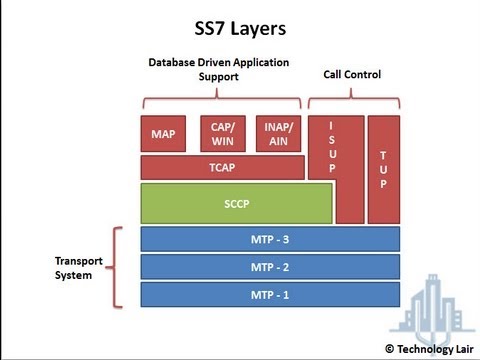
SS7 protocol stackSS7 protocol stack composed of following layers/levels.Physical layer (layer1) - uses time slot no.16 in the case of PCM-30 (2.048 Mbps) and time slot no. 24 in PCM-24 (1.544 Mbps).Data link layer (layer2) - performs functions such as error control, flow control, link initialization and more.Signaling network layer (layer3) - At this layer, each node will have 14 bit address, known as signal point code. Each message exchanged will have source and destination codes.Layer 1 to 3 together forms MTP (Message Transfer Part).Layer 4 or level 4 is called as User part. MTP supports many different user parts. There are three main user parts which include TUP (telephone User Part), DUP (Data UP) and ISDN-UP.SCCP (Signaling Connection Control Part) has been added to level 3 to make compatible to layer-4 of OSI protocol stack.ISP (Intermediate Service Part) performs functions similar to OSI layer 4 to layer 6.
TCAP (Transaction Capabilities Application Part) performs functions similar to OSI layer 7. SS7 Frame structure-HDLCLayer 2 protocol in SS7 follows HDLC frame format in the order as mentioned below.Beginning Flag- 1 octet long, unique pattern 01111110, used to define start of the HDLC frame. Mainly used for synchronization purpose.
Scp In Ss7
Bit stuffing and un-stuffing concept is used to avoid misinterpreting the information having same pattern.Address- 1 or 2 octets long,Control- 1 octet long,Information- variable length,Check- 2 octets long, this field helps detect the error in the frame and hence can request for re-transmission if frame received is in error.End Flag- 1 octet long, unique pattern 01111110, used to define end of the HDLC frame SS7 signal unitsInformation which need to be transmitted by layer-2/level-2 is framed as SU(signal unit). SU follows HDLC frame format as mentioned above. There are three SU types.MSU- Message Signal Unit, transfers information provided by UP via signalling network level at layer3.LSSU- Link Status Signal Unit, performs initialization of link and flow control.FISU- Fill in Signal Unit, used for alignment maintenance when no signal traffic.RF and Wireless tutorials.
Online Sample ChapterDownloadable Sample ChapterDownload - 165 KB - Table of ContentsIntroductionI. INTRODUCTIONS AND OVERVIEWS.1. The Evolution of Signaling.The History of Signaling.1889–1976.1976 to Present Day.Subscriber Signaling.Address Signals.Supervisory Signals.Tones and Announcements.Ringing.Network Signaling.Channel Associated Signaling.Address Signals.Limitations of CAS.Common Channel Signaling (CCS).Circuit-Related Signaling.Non-Circuit-Related Signaling.Common Channel Signaling Modes.Summary.2. Standards.History of International Telephony Standards.ITU-T (Formerly CCITT) International Standards.Regional Standards.ETSI.3rd Generation Partnership Project.3rd Generation Partnership Project 2.National and Industry Standards.ANSI.T1 Committee.Telcordia (Formerly Bellcore).TIA/EIA.ATIS.BSI.NICC.IETF.3.
The Role of SS7.Signaling System No. 7-Based Services.Telephone-Marketing Numbers.Televoting.Single Directory Number.Enhanced 911.Supplementary Services.Custom Local Area Signaling Services (CLASS).Calling Name (CNAM).Line Information Database (LIDB).Local Number Portability (LNP).2nd and 3rd Generation Cellular Networks.Short Message Service (SMS).Enhanced Messaging Service (EMS).Private Virtual Networks.Do-Not-Call Enforcement.Signaling System No. 7: The Key to Convergence.Internet Call Waiting and Internet Calling Name Services.Click-to-Dial Applications.Web-Browser-Based of Telecommunication Services.WLAN “Hotspot” Billing.Location-Based Games.Summary.4. SS7 Network Architecture and Protocols Introduction.Pre-SS7 Systems.History of SS7.SS7 Network Architecture.Signaling Links and Linksets.Routes and Routesets.Node Types.Link Types.Signaling Modes.Signaling Network Structure.SS7 Protocol Overview.MTP.TUP and ISUP.SCCP.TCAP.Summary.5. The Public Switched Telephone Network (PSTN).Network Topology.PSTN Hierarchy.PSTN Hierarchy in the United States.PSTN Hierarchy in the United Kingdom.Access and Transmission Facilities.Lines.Trunks.Network Timing.The Central Office.Main Distribution Frame.The Digital Switch.Switching Matrix.Call Processing.Integration of SS7 into the PSTN.Evolving the PSTN to the Next Generation.Summary.II. PROTOCOLS FOUND IN THE TRADITIONAL SS7/C7 STACK.6.
Message Transfer Part 2 (MTP2).Signal Unit Formats.Fill-In Signal Units.Link Status Signal Units.Message Signal Units.MTP2 Overhead.Field Descriptions.Signal Unit Delimitation.Length Indicator.Signal Unit Alignment.Error Detection.Error Correction.Basic Error Correction.Preventive Cyclic Retransmission.Signaling Link Initial Alignment.Status Indications.Signaling Link Error Monitoring.SUERM.AERM.Processor Outage.Flow Control.Summary.7. Message Transfer Part 3 (MTP3).Point Codes.ITU-T International and National Point Codes.ANSI National Point Codes.Message Format.Service Information Octet.Signaling Information Field (SIF).Signaling Message Handling.Discrimination.Distribution.Routing.Message Load Sharing.Comparing the IP and MTP3 Protocols.MTP3 Message Handling Example.Signaling Network Management.Network Management Messages (H0/H1 Codes).Link Management.Route Management.Traffic Management.MTP3/User Part Communication.Signaling Network Management Example.Summary.8.